
Blog post
Honing Our Edge: A Peek into CSF’s Horizon Scanning Practice
11 August 2026
By Tse Hao Guang
The CSF team has started a new ritual this year—every Monday, we (including interns) spend one hour together discussing the implications of fringe phenomena like human brain cells running data centres (opens in new tab) in Singapore and how conspiracy theories around cloud seeding (opens in new tab) have led to US states banning the technology. We are engaging in horizon scanning: a systematic, collaborative, and iterative process of picking up and making sense of emergent signals of change.
Looking for the “What”
What exactly are these emergent signals of change? This definition works for our purposes: a piece of information about something happening recently, which provides clues to potentially significant futures; it often comes in the form of a small or localised phenomenon. A Chinese billionaire using nannies, IVF and legal firms to birth dozens of US-born surrogate babies (opens in new tab)? An AI agent autonomously publishing a hit piece (opens in new tab) on a developer to shame him into accepting changes to an open-source software project (it later apologised)? Nearly half of Japan’s GDP vulnerable (opens in new tab) to mismanagement, fraud and inactivity as it is held by over-65s with symptoms of cognitive decline? Signal, signal, signal!
CSF picks up signals in all manner of places—through desktop research, where our sources range from odd Substacks to X posts and Douyin videos; touchpoints with our external networks as well as workshops we regularly convene; events; anecdotal observation; and even meetings and interactions with Singapore government colleagues, including those working in foresight at the line agency level. Our principle is to keep signal gathering as wide and frictionless as possible. Analysing what these signals mean for us in our Monday meetings is a complementary but separate part of the work.
Unpacking the “So What”
Our Monday sensemaking meetings are deliberately human-centric and collaborative. This allows us to sharpen discernment in an AI-soaked environment and bring different perspectives to bear on the same signals to surface emergent implications. Each session looks a little different. Once, we each came in with a single “weird” signal and attempted to explain what “weird” meant. Several possible characteristics of “weird” emerged: a disruption to the status quo; an alternative perspective; a challenge to an assumption; and a blind-spot or gap in thinking or awareness. These characteristics have helped us further refine how we understand and explain characteristics of any signal in general, foremost that “weird” is entirely relative.
At another session, we tried out a modified version of Marshall McLuhan’s Tetrad tool for the first time, which we found an easy and intuitive way to discuss a signal by asking four questions. We then introduced the Tetrad at various capability development sessions with other teams, encouraging participants to answer the four questions individually, and then discuss similarities and differences across answers in groups.
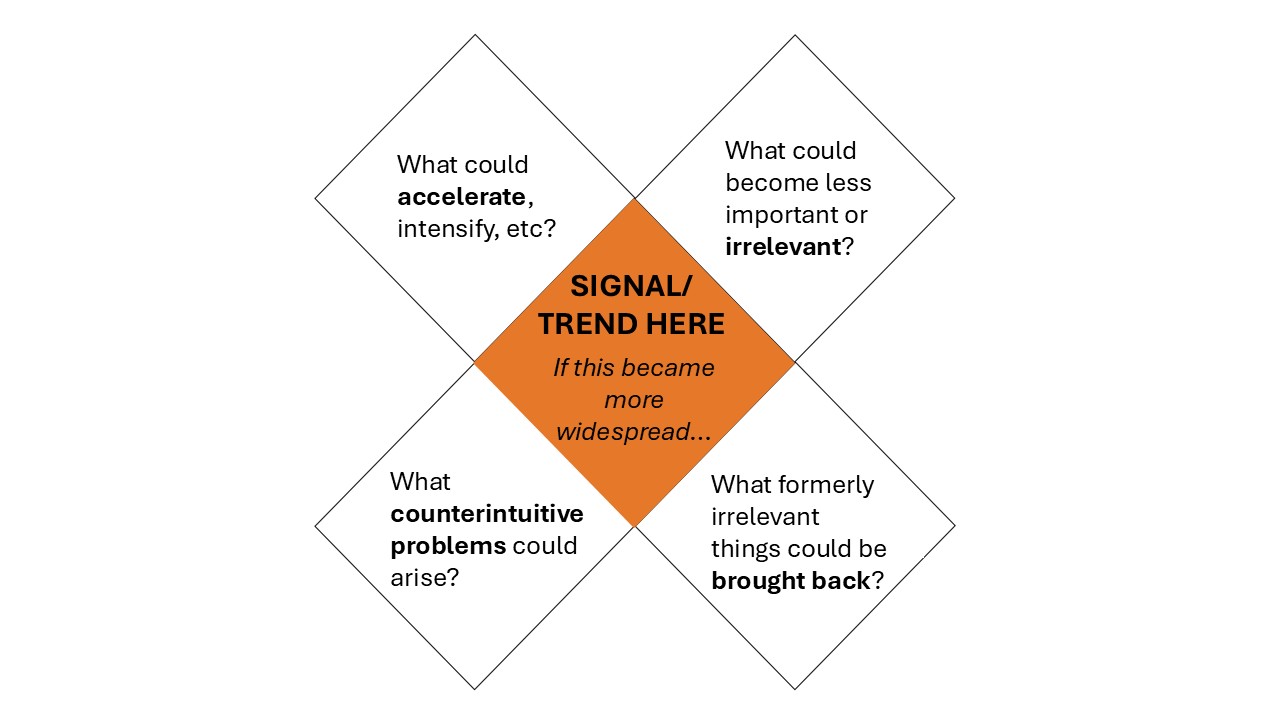
Marshall McLuhan's Tetrad tool
Often, these sensemaking meetings involve clustering signals—grouping signals that speak to potentially larger shifts. These signals may naturally come together: say, Polymarket’s new pop-up “Situation Room” (opens in new tab) bar and the rise of gacha games (opens in new tab) both speak to a growing “gamblification (opens in new tab)” cluster. There are also clusters made up of signals that appear unrelated at first glance: Americans enacting violence (opens in new tab) on food delivery robots and a new practice of booking “door-to-door” personal fitness trainers (opens in new tab) in China may speak to a shift in the kinds of last-mile services that people demand.
“Now what” do we do?
Post-sensemaking sessions, the team works to translate insights gleaned from horizon scanning into useful research and capability development products for the whole of government. Individual signals already add to existing research projects and are widely used as examples in decks. Clusters of signals form the seeds of future research projects and can be used “as-is” to alert other teams to emerging issues. Ranking and prioritising multiple signal clusters alongside colleagues outside of CSF has also been helpful for mutual understanding and translation. We may even use clusters as example topics when teaching other tools like the futures wheel, with participants’ futures wheels not-so-secretly contributing to our sensemaking efforts.
Automating horizon scanning
As we connect with other teams doing horizon scanning, we notice many of them augmenting their efforts with AI (opens in new tab). Thoughtful automation brings massive benefits, including an expanded capacity to sift through “known unknowns” and accessible analysis at factory scale. But AI seems to struggle with picking up signals, underrating those which by definition have only recently occurred or are localised, and therefore which are not well-represented in training data. AI doesn’t do “weird” very well. Human judgement, for us, remains the best way to approach such “unknown unknowns”. That being said, we are keeping tabs on the rapid advancement of AI and AI-assisted foresight, experimenting with it where suitable—especially AI-assisted analysis of human-discovered signals. After all, our processes need to be iterative to respond to our changing world.
And as this world continues to change at a seemingly increasing pace, we suspect the ability to perform horizon scanning will also become increasingly important. This is why we continue to meet every week. But we can’t deny that sensemaking discussions—free-flowing, untethered to concrete outcomes for the moment—are also really fun. The future may be uncertain, but that’s not always a bad thing!
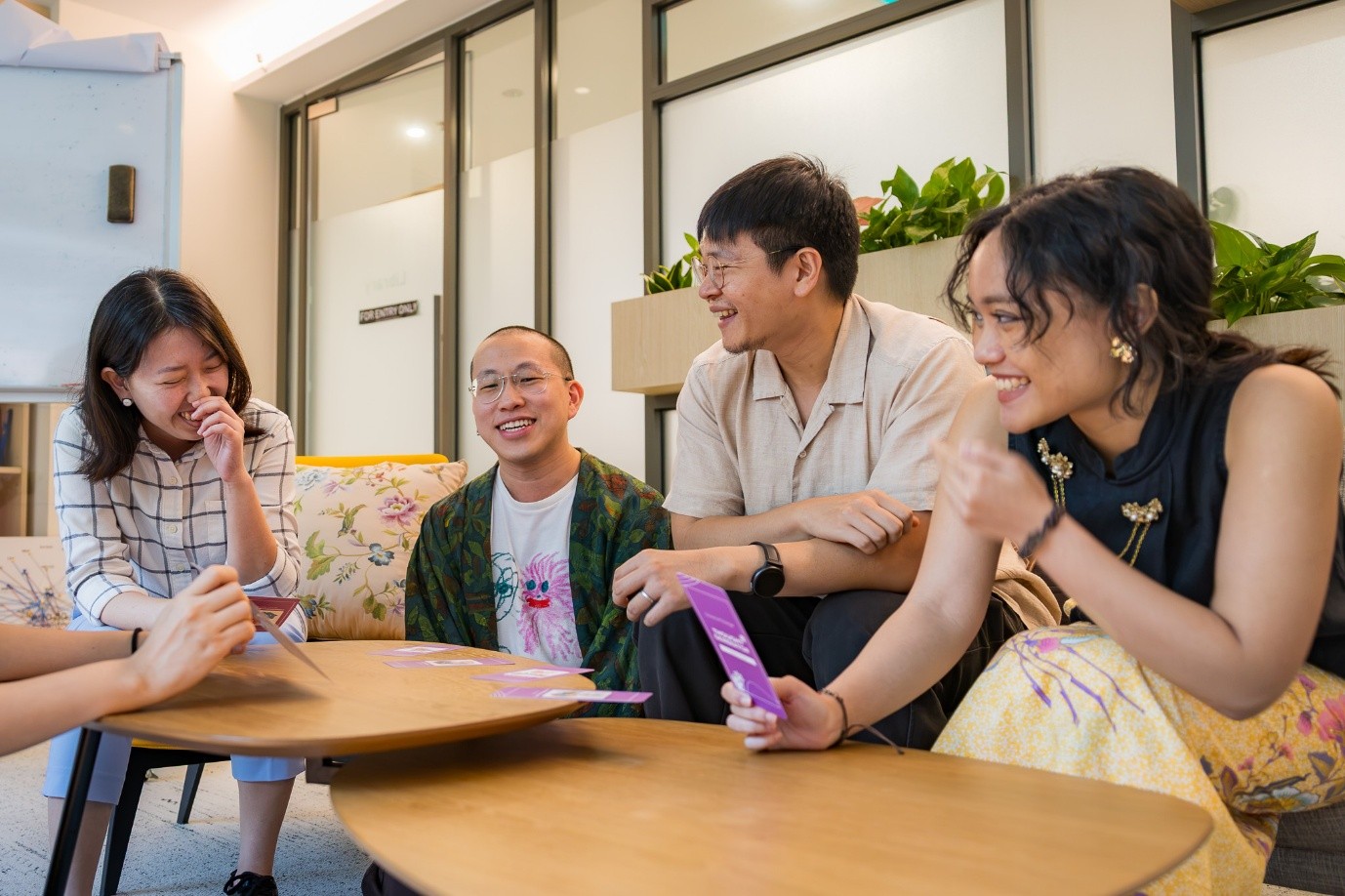
This is a completely unstaged photograph showing the incredible amounts of fun the team has sensemaking signals 😊 Picture credits: Matthew Lim
With thanks to the entire CSF team for collectively contributing to all the signals in this post, as well as to the insights gleaned from sensemaking. Special thanks to Lim Yun Hui for co-organising and leading many sensemaking sessions!
The views expressed in this blog are those of the authors and do not reflect the official position of Centre for Strategic Futures or any agency of the Government of Singapore.